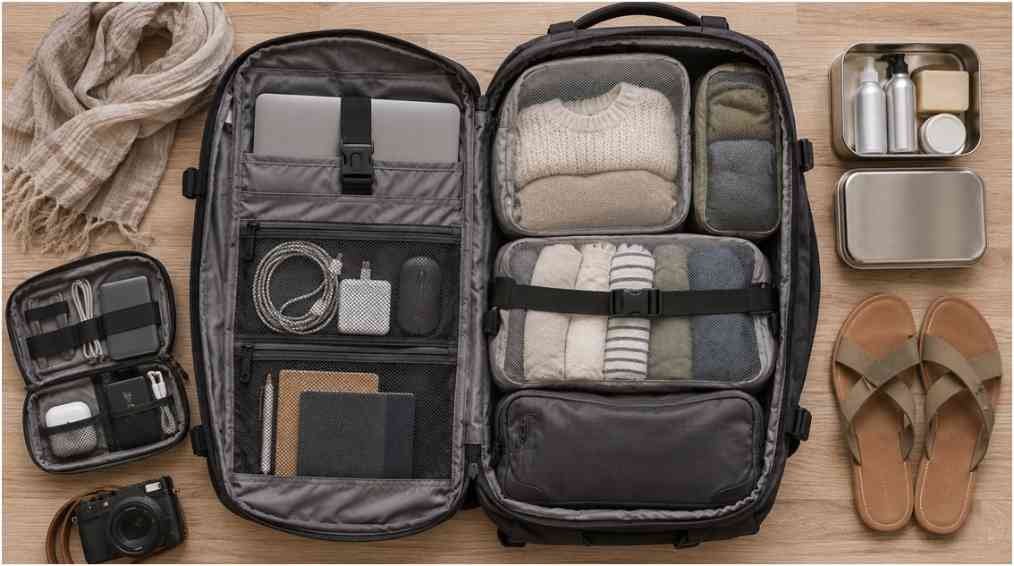
After four years working across 19 countries, I learned that checking a bag destroys your freedom on travel days. A functional digital nomad packing list for long term remote work fits inside a single 35L to 40L carry-on backpack while protecting your posture during eight-hour workdays.
Overpacking forces you into expensive baggage fees, slow airport transfers, and back pain on cobblestone streets. Every item below earned its spot after surviving regional flights, cramped cafes, and humid co-working spaces.
Why Weight Limits Dictate Every Gear Choice
Budget carriers across Asia and Europe strictly enforce 15-pound (7kg) to 22-pound (10kg) carry-on limits. Gate agents weigh backpacks before boarding, and exceeding that limit costs up to $80 per flight leg.
Through trial and error, I capped my total packed weight at 18 pounds (8.2kg). My mobile office accounts for 6.5 pounds, clothing takes 7 pounds, and my empty backpack plus toiletries make up the remaining 4.5 pounds. Knowing your exact weight distribution prevents frantic repacking at the airport gate.
Remote Workstation and Tech Gear That Saves Your Neck
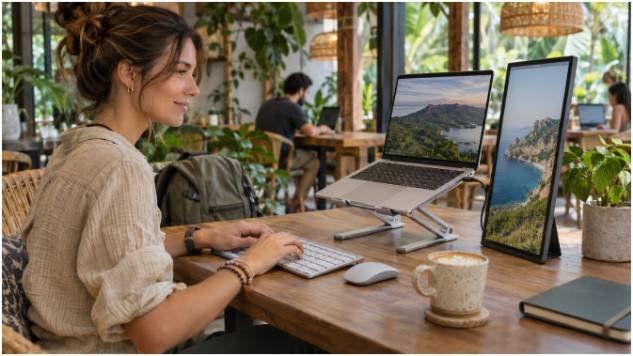
Working from kitchen tables and low coffee shop couches wrecks your upper back within two weeks. Following OSHA computer workstation guidelines, your screen top should sit at or slightly below eye level. You cannot achieve that posture with a laptop resting flat on a desk.
Primary Laptop, Riser, and Input Devices
I carry a 14-inch lightweight laptop protected inside a neoprene sleeve alongside a microfiber screen cloth. To fix my posture anywhere, I pack the ALOGIC Metro Adjustable & Portable Laptop Riser. Its lightweight aluminum frame locks into six viewing angles, and non-slip silicone pads keep my machine steady while I type fast.
Raising your screen requires external inputs so your wrists stay neutral. I pair my riser with a low-profile mechanical travel keyboard and a compact wireless mouse. This trio weighs under 1.5 pounds total and transforms any unstable table into a proper desk.
Portable Second Monitors for Split-Screen Productivity
Switching between tabs on a single screen slows down data analysis, coding, and content editing. Adding an Asus ZenScreen MB169CK 15.6″ Portable USB-C Monitor doubled my daily output without adding bulk.
This anti-glare Full HD IPS panel connects via a single USB-C cable and weighs less than two pounds. Its 360-degree kickstand rotates smoothly between landscape and portrait modes, making long documents and spreadsheets effortless to read. When I wrap up work, it slides straight into my backpack’s laptop sleeve.
Global Power, GaN Chargers, and Connectivity
Carrying separate power bricks for your laptop, phone, and tablet wastes valuable space. I replaced three bulky chargers with one Portronics Adapto 65U Universal Wall Charger. This 65W Gallium Nitride (GaN) brick features dual Type-C Power Delivery ports and four interchangeable international plug heads.
For power outages and long transit days, I pack a 20,000mAh power bank alongside two braided six-foot USB-C cables. Keep in mind that FAA lithium battery rules strictly prohibit spare lithium batteries and power banks in checked luggage, so always keep them in your carry-on.
Rounding out my tech kit are active noise-canceling earbuds for client calls and an unlocked smartphone running dual eSIMs. Installing a regional data plan before landing ensures I have instant maps and messaging the second my plane touches the tarmac. Establishing a reliable daily routine for remote workers becomes much easier when your tech setup works reliably from day one.
The 7-Day Capsule Wardrobe for Four-Season Travel
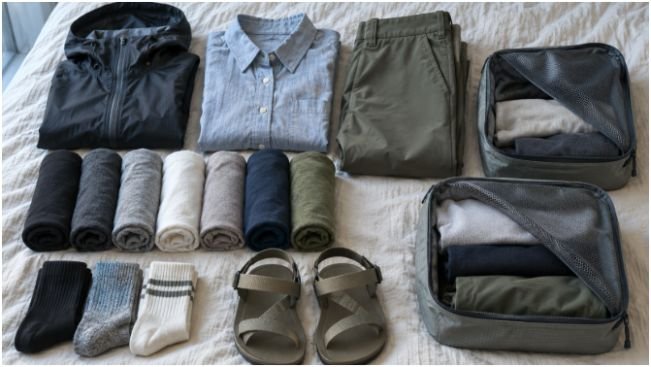
Packing for three months requires the exact same amount of clothing as packing for seven days. Laundromats, wash-and-fold services, and apartment washing machines exist in every major hub worldwide. I select wrinkle-resistant, quick-drying fabrics like merino wool and technical nylon blends that resist odors between washes.
Breathable Tops, Bottoms, and Layering Systems
My upper-body rotation consists of six tops: four neutral merino t-shirts, one collared button-down for video meetings, and one lightweight long-sleeve sun shirt. Neutral colors like charcoal, navy, and olive ensure every shirt matches every pair of pants without thought.
For bottoms, I pack one pair of four-way stretch travel trousers, one pair of hybrid shorts that double as swimwear, and lightweight joggers for flights and lounging. Climate shifts happen fast when flying between continents, so I rely on a two-layer outerwear system. A breathable merino wool zip cardigan handles chilly air-conditioned cafes, while a packable waterproof rain shell blocks wind and downpours.
Multi-Terrain Footwear and Undergarments
Shoes eat up more luggage volume than any other item, so I enforce a strict two-pair maximum on my feet and in my bag. I wear versatile, dark-colored trail-to-city walking sneakers on transit days and pack flat, Packable slip-on sandals for beaches, showers, and warm evenings.
Inside my bag, I store eight pairs of moisture-wicking boxer briefs and seven pairs of merino wool ankle socks. Merino socks regulate temperature in both tropical heat and mountain chill, allowing me to hand-wash them in a hotel sink overnight.
Carry-On Luggage and Modular Organization Systems
Top-loading hiking backpacks force you to dump your entire wardrobe onto the bed just to find a charger. I use a 38L clamshell carry-on travel backpack that opens flat like a suitcase and includes a suspended, padded laptop compartment. For daily coffee shop runs, I pack a foldable 18L daypack that stuffs into a pouch the size of a soda can.
Internal organization separates chaotic packers from calm travelers. I compress my clothes inside a Thule Compression Cube Set. These water-repellent ripstop nylon cubes use heavy-duty compression zippers to squeeze out trapped air, shrinking my wardrobe volume by nearly 30 percent. All dongles, SD cards, spare cables, and my universal adapter live inside a dedicated zip-up tech pouch so nothing gets left behind at checkout.
Solid Toiletries, Medical Kits, and Backup Documents
Liquid spills ruin electronics faster than anything else on the road. I eliminated bottle leaks by switching to solid shampoo bars, solid conditioner, and a hard deodorant stick stored in breathable aluminum tins. For liquid essentials like sunscreen and moisturizer, I use refillable 100ml silicone tubes compliant with TSA carry-on liquid restrictions. Everything hangs neatly from bathroom hooks inside a compact organizer alongside a fast-drying microfiber towel.
Your health kit should handle minor emergencies before you navigate a foreign pharmacy. I carry a compact pouch stocked with:
- Prescription medications in original packaging alongside digital doctor notes
- Ibuprofen, antihistamines, and loperamide for sudden stomach issues
- Electrolyte hydration packets for food poisoning or long-haul jet lag
- Adhesive bandages and antiseptic wipes for minor cuts
Before departing, verify regional vaccine and health advisories through the CDC Travelers’ Health portal. Finally, store physical backup debit and credit cards separately from your primary wallet.
Keep encrypted digital scans of your passport, international driving permit, and travel medical insurance policy in cloud storage accessible offline. Having these systems locked in frees up mental bandwidth so you can focus on client deliverables and stay motivated working alone in unfamiliar cities.
Digital Nomad Packing List FAQs
1. What is the best backpack size for long-term digital nomads?
A 35L to 40L clamshell backpack fits international carry-on dimensions while holding a full mobile workstation and seven days of clothing.
2. How many pairs of shoes should a digital nomad pack?
Pack two pairs maximum: one versatile walking sneaker worn on flights and one lightweight pair of sandals or packable flats.
3. Can I bring a portable monitor and power bank in my carry-on?
Yes, both items are allowed in carry-on luggage, though lithium power banks must stay under 100Wh (roughly 27,000mAh) per aviation rules.
4. How do digital nomads do laundry while traveling full-time?
Most nomads pack for seven days and use local drop-off wash-and-fold laundromats, Airbnb washing machines, or sink-wash quick-dry merino garments.
Zip Up, Weigh In, and Take the Window Seat
Freedom on the road starts the moment you stop dragging heavy suitcases across train platforms. Lay your gear out on your living room floor tonight, weigh your packed bag on a standard bathroom scale, and ruthlessly cut anything that serves only one purpose. Once your entire life fits comfortably on your shoulders, book that one-way ticket and get to work.