
Most companies do not actually need to retrain an AI model to make it understand their internal information. The more practical answer to how to train custom ai models on company knowledge base content is usually retrieval-augmented generation, or RAG. Instead of repeatedly changing a large language model’s underlying weights, RAG gives the model controlled access to current company documents when a question arrives.
That distinction matters. Policies change. Product specifications get revised. Pricing changes. New support issues appear. A system that retrieves current information can reflect those changes much faster than a model whose knowledge has been baked into a training run.
Research from UC Berkeley has also shown why retrieval matters: language models can struggle with less-common knowledge unless the necessary context is supplied at inference time.
“Training” Your Company AI Usually Means Building a Retrieval System
Traditional model training modifies neural-network parameters using a training dataset. Fine-tuning does something similar on a smaller scale to teach a pretrained model new behaviors or domain patterns. RAG works differently. Your original documents stay outside the language model. The system searches those documents when someone asks a question, selects relevant passages and gives those passages to the LLM as temporary context.
UC Berkeley research describes RAG as an approach that allows models to reference retrieved documents while answering questions, while fine-tuning can be useful for adapting behavior to specialized tasks. That means a company might use RAG for changing knowledge such as HR policies, technical documentation and product catalogs, while using fine-tuning for consistent classification, writing style or specialized workflows.
For teams already exploring broader development applications, these AI tools for website development provide useful context on where AI can fit into a larger software stack.
Step 1: Fix the Knowledge Base Before Adding AI

An AI assistant cannot reliably resolve an organizational documentation problem that employees have already failed to resolve. Start by inventorying the information the system may need: SOPs, product manuals, internal wiki pages, support articles, contracts, training materials, FAQs, approved sales material and technical documentation. Then identify duplicates and contradictions.
If one document says refunds are permitted for 30 days and another says 45 days, semantic search may retrieve both. The language model then has to decide which one deserves more trust.
SLAC, operated by Stanford University, reports using AI-enabled enterprise search not only to improve information discovery but also to identify duplicate and outdated internal information. A useful rule is simple: every important policy should have an identifiable owner, effective date and authoritative version.
Step 2: Add Permissions Before Embeddings
Do not dump an entire corporate drive into one vector database and assume the chatbot will know what each employee is allowed to see. Classify data first. Separate public material, company-wide information, department-specific documents and highly restricted records. The retrieval layer should evaluate the user’s identity and permissions before returning document chunks.
This is especially important for payroll records, customer information, contracts, legal files and security documentation.
The NIST AI Risk Management Framework encourages organizations to incorporate trustworthiness and risk management throughout the AI lifecycle rather than treating governance as an afterthought.
Permissions should therefore be enforced by software outside the LLM. Never rely on a prompt saying, “Do not reveal confidential documents.”
Step 3: Chunk Documents for Retrieval
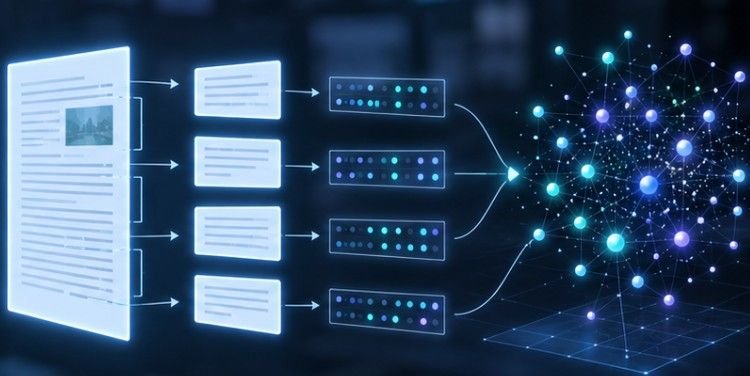
A 200-page employee handbook should not normally become one searchable object. Documents are usually divided into smaller chunks containing enough context to answer a specific question. Each chunk can also carry metadata such as its source, department, publication date, document ID, access level and version.
Next, an embedding model converts each chunk into a numerical representation called a vector. When someone searches for “How much parental leave do employees receive?”, the system embeds that question and searches the vector index for semantically related passages.
The winning chunks—not the entire company repository—are passed to the LLM. This architecture makes how to train custom ai models on company knowledge base information more manageable because documents can be added, replaced or removed without repeating full model training.
Step 4: Build the Retrieve-Then-Generate Pipeline

A basic production workflow looks like this:
Question → Authentication → Retrieval → Permission filtering → Reranking → LLM → Source-backed answer
Reranking deserves attention. Vector similarity alone does not always select the best evidence. A second retrieval or ranking stage can help prioritize authoritative, recent and directly relevant passages. More advanced systems can combine keyword search, semantic retrieval and knowledge graphs.
Carnegie Mellon University researchers, for example, have explored systems that combine structured operational knowledge with RAG so AI assistants can produce advice linked more closely to real-world expert processes.
Companies experimenting with discovery and optimization workflows can also review these AI-powered SEO tools for beginners to understand another practical application of retrieval and AI-assisted analysis.
Step 5: Make the AI Prove Where Its Answer Came From
A convincing answer is not necessarily a correct answer. Require your application to return source citations or document references alongside important responses. Employees should be able to open the supporting policy, manual or knowledge-base article.
This creates a simple but powerful rule:
If the system cannot retrieve enough evidence, it should say so rather than confidently inventing an answer.
A useful pre-launch evaluation set might contain 100–200 representative questions divided among easy lookups, ambiguous requests, multi-document questions, outdated-policy traps, permission tests and questions with no valid answer.
For each response, measure whether the correct document was retrieved, whether the final claim was supported and whether restricted material remained inaccessible.
Fine-Tuning vs. RAG: Know Which Problem You Are Solving
Fine-tuning still has a place. Use it when you want the model to consistently classify support tickets, follow a specific output structure, adopt specialized terminology or perform a repetitive domain-specific task. Do not make it your first choice simply because employees want the chatbot to “know our documents.” Company knowledge changes too frequently.
For many organizations investigating how to train custom ai models on company knowledge base material, the strongest architecture is actually hybrid: RAG supplies current facts while carefully selected prompts or fine-tuning shape how the model behaves.
The Security Problem Companies Often Miss
RAG creates new security risks because the model is reading material that may contain malicious or manipulated instructions.
OWASP warns about document poisoning, embedding weaknesses, unauthorized retrieval and indirect prompt injection in RAG systems. A malicious document placed inside a shared repository could contain instructions intended to influence the model when that document is retrieved.
The OWASP RAG Security Cheat Sheet recommends controls including document provenance, approved source lists, access restrictions, retrieval limits, output validation and monitoring. Treat retrieved material as data—not trusted instructions.
For another research perspective, the UC Berkeley research on long-tail knowledge demonstrates why providing relevant external context can substantially improve performance on knowledge that models encounter less frequently.
FAQs
1. Do I need to fine-tune an AI model on company documents?
Usually not. RAG is generally better for frequently changing company knowledge because documents can be updated independently without retraining the model.
2. What is the best data format for a company AI knowledge base?
Clean text with meaningful headings and metadata works well. PDFs, wiki pages and documents can also work if extraction preserves structure, dates, ownership and access permissions.
3. Can RAG completely stop AI hallucinations?
No. Retrieval can improve grounding, but poor retrieval, contradictory sources or model errors can still produce incorrect answers. Evaluation and source attribution remain essential.
4. Can confidential company information be used safely?
It can be protected more effectively when retrieval enforces identity-based access controls, encryption, logging and data classification. Sensitive information should never rely solely on prompt-based restrictions.
Final Thoughts
The hardest part of creating a company-aware AI system is rarely the language model. It is deciding which information deserves trust, who should have access to it and how the system proves that an answer came from legitimate evidence.
Clean the knowledge base first. Establish permissions next. Then build retrieval, citations, evaluation and monitoring around the model.
That architecture gives companies something much more useful than an AI that has merely memorized old documents. A system capable of finding the right company knowledge at the moment employees actually need it.