

A successful subscription payment does not guarantee that a customer will receive the service they purchased. A delayed webhook, incorrect pricing configuration, or failed renewal can leave users paying for features they cannot access.
Understanding how to implement subscription billing in a SaaS application means building more than a recurring payment system. It requires reliable billing infrastructure, accurate subscription tracking, secure payment processing, and automated access management.
For US-based SaaS businesses, the challenge also includes sales tax requirements, subscription disclosures, and cancellation policies. Getting these details right before launch can prevent expensive problems as customer numbers grow.
Choose a Billing Platform That Matches Your Business
The first decision is whether to develop recurring billing infrastructure internally or use an established provider.
For most startups, a specialized billing platform reduces development complexity and ongoing maintenance.
Compare Payment Providers and Billing Models
Stripe Billing supports recurring subscriptions, invoicing, usage-based pricing, and customer management. Polar offers billing services under a merchant-of-record model, while Clerk Billing can simplify subscription integration for applications using Clerk authentication.
Your choice should depend on pricing complexity, supported markets, payment methods, tax responsibilities, and integration requirements.
A direct payment processor generally leaves the SaaS company responsible for applicable tax obligations. A merchant of record typically assumes the seller’s role for transactions it processes, subject to its contractual coverage.
Understand Payment Security Responsibilities
Outsourcing card processing reduces exposure to sensitive payment information, but it does not automatically eliminate compliance responsibilities.
The PCI Security Standards Council explains that merchants using third-party processors can still have PCI DSS obligations.
Hosted checkout pages are often preferable for smaller development teams because payment information is collected by the provider rather than the application.
Build a Pricing Structure Before Writing Billing Code
A subscription system works best when pricing rules are clearly defined before implementation.
Common SaaS pricing approaches include flat monthly fees, per-user subscriptions, metered usage, and combinations of these models.
For example, a collaboration platform might charge $20 per organization plus $8 per additional user. The billing engine must calculate those charges consistently and explain them clearly to customers.
Separate Subscription Plans From Feature Permissions
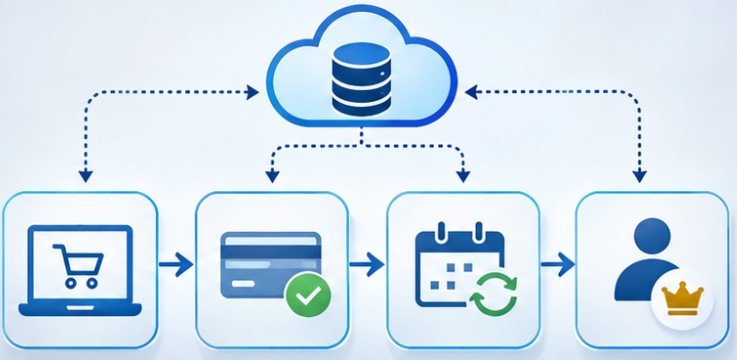
One important architectural decision is keeping billing records separate from application entitlements.
Billing records describe what customers purchased. Entitlements determine which features, limits, and services they can access.
A practical database might contain customer, organization, subscription, plan, entitlement, and usage records. Every subscription should reference its provider identifier, billing period, current status, and renewal date.
Instead of checking payment history every time a customer opens a feature, the application can evaluate locally synchronized permissions.
This approach also allows grandfathered pricing, promotional plans, and enterprise agreements without rewriting access-control logic.
Create a Secure Checkout and Account Management Experience
When developers research how to implement subscription billing in a SaaS application, checkout integration often receives the most attention. However, the account management experience deserves equal consideration.
Connect Checkout to Authenticated Accounts
Start by creating a backend endpoint that identifies the authenticated customer and validates the requested pricing plan.
For Stripe Checkout, a subscription session can use mode: “subscription” and a server-approved price identifier. Never trust pricing values submitted directly from the browser.
Associate the resulting billing customer with an internal user or organization identifier. Store that relationship securely so webhook events can update the correct account.
Give Customers Control Over Their Subscriptions
A self-service billing portal should allow customers to update payment details, retrieve invoices, change plans, and cancel subscriptions.
Clearly explain whether upgrades take effect immediately, whether unused time is credited, and when downgrades become effective.
Customers managing multiple SaaS products also benefit from understanding how to reduce unused SaaS subscriptions in a business. Transparent account controls improve usability while reducing routine support requests.
Use Webhooks to Keep Subscription Records Accurate

Payment platforms communicate subscription changes through webhook events.
These server-to-server notifications help the application respond when payments succeed, subscriptions change, or renewals fail.
Typical Stripe events include checkout.session.completed, invoice.paid, invoice.payment_failed, and customer.subscription.updated.
The application should verify webhook signatures before processing events and never grant premium access merely because a checkout redirect succeeded.
Prevent Duplicate Events and Incorrect Access
Webhook providers may retry notifications or deliver events outside their original sequence. The OWASP Webhook Security Cheat Sheet recommends security controls including authentication, replay protection, and idempotent processing.
Store processed event identifiers and use atomic database operations to prevent duplicate credits or inconsistent records.
For important subscription changes, retrieve the latest state from the payment provider rather than assuming events arrive in order.
A scheduled reconciliation job can also compare local subscription records against provider data and repair missed updates.
Handle Payment Failures Without Losing Customers
A declined payment should trigger a recovery process rather than an immediate, unexplained account suspension.
Configure automatic retry attempts, payment-update notifications, and a clearly defined grace period.
For example, a business might allow three days of limited continued access while a customer replaces an expired card.
The appropriate policy depends on operating costs, product risk, and contractual obligations.
Track recovery rates, failed invoices, involuntary churn, and outstanding payments to identify recurring problems.
Address US Tax Rules and Subscription Compliance
Subscription billing creates obligations that extend beyond software engineering. The Streamlined Sales Tax Governing Board explains that taxability and sales tax rules vary across participating states.
Businesses should evaluate economic nexus, customer location, applicable exemptions, and whether their software offering is taxable. Cancellation rules also matter.
The FTC’s 2024 Click-to-Cancel amendments were vacated in July 2025, but other federal requirements and state automatic-renewal laws remain relevant. The Federal Trade Commission continues to enforce protections against deceptive subscription practices.
Businesses should provide clear renewal disclosures, obtain appropriate consent, and support straightforward cancellation.
Test the Full Subscription Lifecycle Before Launch

Testing only a successful first payment leaves critical billing failures undiscovered.
Use payment-provider sandbox environments and subscription test clocks to simulate renewals, trial expiration, upgrades, cancellations, and failed payments.
Test whether duplicate webhooks change balances, whether a canceled account retains access until its paid period ends, and whether unpaid subscriptions eventually lose premium permissions. Also verify annual billing, tax calculations, discounts, and usage limits.
The OWASP Third-Party Payment Gateway Integration guidance emphasizes validating transactions through trusted backend processes rather than relying on browser responses.
Before production deployment, configure monitoring for failed webhook deliveries, subscription mismatches, and unexpected changes in payment success rates.
Frequently Asked Questions
1. What is the easiest way to add recurring payments to SaaS?
A hosted checkout service with subscription APIs is usually the simplest approach. It reduces payment-form development and provides established billing features.
2. Can SaaS subscriptions support usage-based billing?
Yes. Metered billing platforms can charge according to API requests, storage consumption, transactions, or other measurable activities.
3. How should a SaaS application handle canceled subscriptions?
Keep access active until the paid service period ends unless the agreement specifies otherwise. Update entitlements automatically when cancellation becomes effective.
4. How long does subscription billing integration take?
A basic hosted checkout integration may take days. Production-ready implementations involving tax, metering, webhooks, reconciliation, and extensive testing can require several weeks or longer.
Build a Billing System Customers Can Trust
The strongest SaaS billing systems are almost invisible to customers. Payments renew correctly, invoices remain accessible, and account permissions match what users purchased.
Learning how to implement subscription billing in a SaaS application requires treating reliability, security, and customer transparency as essential product features.
Start with a proven billing provider, establish clear pricing rules, and connect subscription changes to server-side access controls. Test failures as carefully as successful transactions.
Most importantly, measure the system after launch. A small billing inconsistency affecting hundreds of customers can become a substantial financial and reputational problem. Reliable recurring revenue begins with reliable recurring billing.