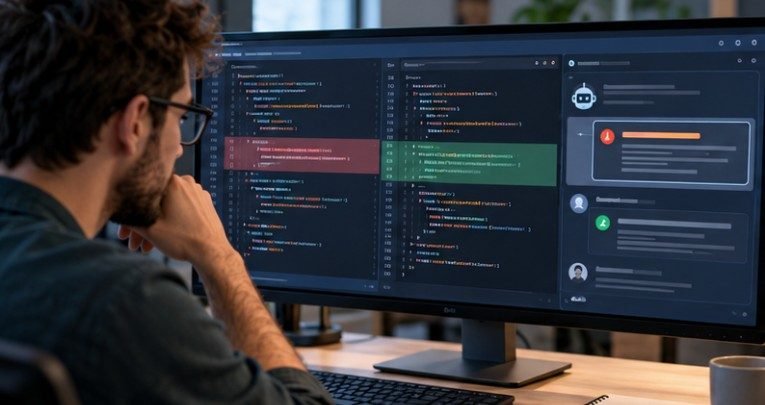
A code review does not have to miss a bug to fail. Sometimes the real failure is finding the bug three weeks later, after it has reached QA, production, or a customer.
That timing explains much of how do AI code review tools improve software quality. Their biggest advantage is not replacing engineers with automated comments. It is moving defect detection closer to the moment code changes, while giving human reviewers more time to investigate architecture, security, and business logic.
Tools such as CodeRabbit, SonarQube, and GitHub Copilot’s pull-request review capabilities increasingly go beyond conventional linting. They can examine surrounding functions, tests, dependencies, configuration, and change context before explaining why a piece of code deserves attention.
AI Code Review Moves Quality Checks Earlier
Traditional peer review has an unavoidable constraint: human attention. A senior developer may have only a few minutes to review a pull request while balancing feature development, meetings, incidents, and other reviews. Static analysis helps, but conventional rule-based tools are usually strongest at predefined patterns rather than understanding why a change was made.
AI-powered reviewers add another layer. They can summarize a pull request, trace relationships between changed components, surface suspicious logic, and translate findings into explanations developers can act on.
That fits closely with the NIST Secure Software Development Framework, which recommends integrating practices that reduce vulnerabilities throughout the software development lifecycle. NIST’s DevSecOps guidance also specifically identifies automated code analysis as a way to lower the effort required to identify vulnerabilities before release. The practical gain is simple: developers receive useful feedback while the code and its intent are still fresh.
AI Can Find Problems That Basic Linters Cannot
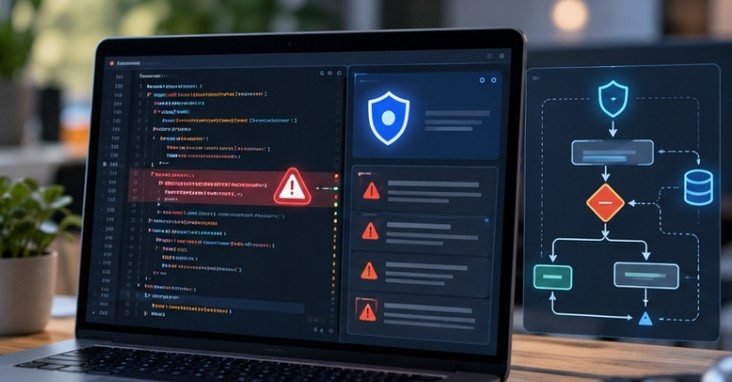
It looks for behavioral mistakes, not just syntax
A linter can detect an unused variable or formatting violation. An AI reviewer can potentially notice that a refund function permits negative values, an error path silently loses data, or a pagination routine skips the final result. Those problems may compile perfectly.
Context-aware review is particularly useful for missing null checks, boundary conditions, inconsistent state changes, questionable error handling, and concurrency risks. Instead of analyzing every line independently, the reviewer can reason about how a changed block interacts with nearby code.
That does not guarantee the finding is correct. It gives human reviewers another set of eyes focused on patterns they might otherwise overlook.
Security defects can surface before deployment
Security provides an even stronger case for automated review. AI-assisted tools can identify suspicious SQL construction, hardcoded credentials, weak input validation, unsafe deserialization, missing authorization checks, risky configurations, and excessive privileges.
The persistence of such problems is not theoretical. CISA and the FBI have specifically urged software manufacturers to formally review code for SQL injection, despite the vulnerability class being understood for decades.
The MITRE Common Weakness Enumeration program currently catalogs hundreds of software and hardware weakness types. That breadth illustrates why relying on developer memory alone is unrealistic. AI review can turn those known weakness patterns into earlier warnings inside the development workflow.
Maintainability Improves Alongside Security
Software quality is not limited to whether today’s release works. Good code must remain understandable and changeable months later.
AI reviewers can highlight duplicated logic, excessive nesting, long functions, unclear names, tight coupling, dead code, and responsibilities that have been packed into one component. More importantly, they can often explain a refactoring opportunity instead of merely reporting a complexity score.
Teams already using established software design patterns can configure review processes around architectural expectations. For example, an AI reviewer could flag a new database call inside a presentation layer or identify code that bypasses an established abstraction. This turns automated review into a guardrail against gradual architectural drift.
AI Review Can Reveal the Tests You Forgot
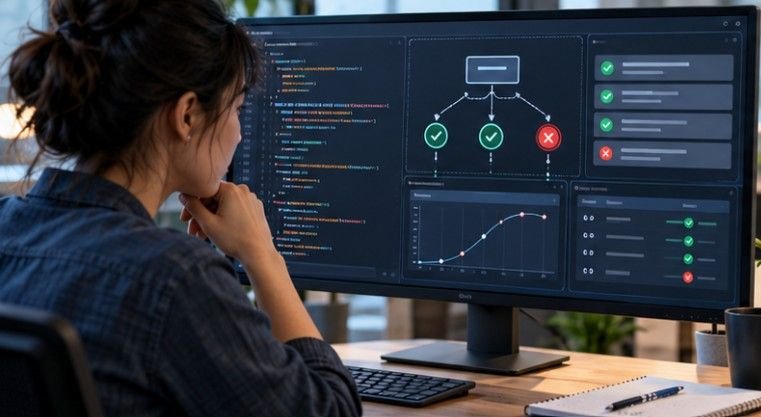
One of the most useful applications is identifying missing test scenarios. Suppose a developer modifies an API integration. The existing happy-path test passes. An AI reviewer can still ask what happens if the API returns a rate-limit response, the network times out, malformed data arrives, or the database succeeds while a downstream operation fails.
It may then suggest unit, integration, or regression tests for those conditions. The important goal is not generating the largest number of tests. Automatically generated tests can create false confidence when they merely mirror the implementation. Effective review targets meaningful boundaries and failure modes.
The OWASP Secure Code Review emphasizes areas including input validation, authentication, authorization, cryptography, business logic, configuration, race conditions, and trust boundaries. These are precisely the areas where thoughtful testing adds more value than another routine happy-path assertion.
Consistent Standards Become Easier to Enforce
Large engineering organizations rarely have one repository, programming language, or development team. Standards inevitably drift. AI review can help enforce naming rules, error-handling conventions, documentation requirements, approved architectural approaches, and security practices repeatedly across repositories.
That becomes especially important for regulated development. Teams creating higher-risk products should connect AI-generated findings to documented processes rather than allowing a model’s recommendation to become policy by default.
For example, organizations building healthcare technology should align reviews with established software development standards for medical devices and applicable quality requirements.
The SEI CERT secure coding resources similarly focus on preventing coding defects that can become exploitable vulnerabilities, reinforcing the value of consistent engineering rules.
A Five-Step Test for Choosing an AI Code Reviewer
Before deploying a tool company-wide, test it against representative pull requests rather than relying on feature lists.
- First, measure signal quality. Determine how many comments identify genuine defects, meaningful security risks, or worthwhile maintainability improvements.
- Second, check context awareness. Can the reviewer understand related files, tests, API contracts, and repository conventions, or does it effectively review only the diff?
- Third, test security depth. Use controlled examples containing weak validation, authorization errors, injection-prone patterns, and exposed test secrets.
- Fourth, evaluate actionability. A useful comment should explain the problem, its likely effect, and a reasonable fix.
- Finally, measure noise. A system posting dozens of low-value comments can condition developers to ignore everything it says.
Useful metrics after deployment include false-positive rate, accepted recommendations, review turnaround time, escaped defects, and security issues discovered before release.
Connecting these measurements with broader secure software development best practices also helps turn individual findings into lasting process improvements.
Where AI Review Still Falls Short
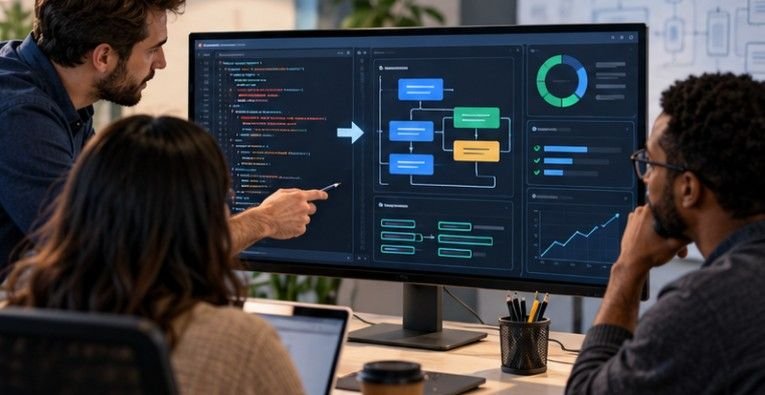
The biggest misconception is assuming an AI reviewer understands a product exactly as its engineers do. It may misunderstand intentional design choices, overlook unusual business rules, suggest nonexistent APIs, exaggerate harmless security findings, or recommend a technically plausible change that introduces another problem.
Human judgment remains essential around authentication, complex authorization, financial calculations, privacy controls, concurrency, cryptography, architecture changes, and safety-critical systems. OWASP itself describes automated tools as complementary to human security review because application-specific business logic and contextual vulnerabilities still require expert judgment.
The stronger model is layered: deterministic linters catch known rules, AI identifies contextual concerns, tests verify behavior, security tooling examines vulnerabilities, and engineers make the final decision.
Frequently Asked Questions
1. Can AI code review replace human code review?
No. AI can accelerate defect detection and suggest fixes, but humans remain essential for architecture, business logic, security context, trade-offs, and final accountability.
2. How do AI code review tools improve software quality in CI/CD?
They continuously inspect changes, identify defects earlier, suggest missing tests, flag security risks, and enforce repository standards before code reaches production.
3. Are AI code review tools reliable for security?
They are useful as an additional security layer. Teams should still use static analysis, dependency scanning, testing, threat modeling, and qualified human security review.
4. What metrics should teams track?
Measure useful findings, false-positive rates, accepted suggestions, review turnaround time, escaped defects, and security vulnerabilities discovered before release.
The Better Review Model Is Human Plus Machine
The real answer to how do AI code review tools improve software quality is not that machines become better software engineers than people. It is that every pull request can receive a useful first pass before scarce human attention is spent.
Use AI to expose routine defects, questionable security patterns, missing tests, maintainability problems, and inconsistent standards. Keep engineers responsible for intent, architecture, risk, and approval.
The competitive advantage will belong to teams that stop treating AI and human review as alternatives. Software quality improves most when automation handles repetitive inspection and experienced engineers spend their attention on decisions where context actually matters.