

Two years into working from my spare bedroom, I realized I wasn’t working from home—I was sleeping at my office. My laptop stayed open on the kitchen counter until midnight, and my shoulders lived permanently near my ears. Building a strict daily routine for remote workers to avoid burnout didn’t just save my sanity; it doubled my actual output while cutting my screen time by three hours a day.
When your commute shrinks to twelve steps in fuzzy socks, your brain loses the environmental cues it relies on to switch gears. You don’t need another generic productivity hack. You need physiological guardrails that force your nervous system to clock out.
Why Traditional Work Schedules Fail at Home
In a traditional office, friction protects your time. Coworkers walk away from their desks at five, building lights dim, and traffic forces you to stop typing. At home, that friction vanishes. According to research highlighted by the American Psychological Association, blurred boundaries between domestic space and professional obligations are the primary drivers of chronic remote fatigue.
When I first went remote, I tried to mirror my old 9-to-5 schedule hour for hour. It failed miserably because remote communication demands constant micro-decisions. Every Slack ping triggers a tiny cortisol spike. Over eight hours, those micro-stresses compound into total exhaustion, even if you never left your ergonomic chair.
Phase 1: The Morning Transition Ritual (7:00 AM – 8:30 AM)

How you spend your first sixty minutes dictates your nervous system’s baseline for the entire day. If you roll over and check work email in bed, you immediately surrender your focus to everyone else’s emergencies.
Replacing the Missing Commute
I used to mock the idea of a “fake commute” until I tracked my focus levels with and without one. Without a buffer, my brain stayed foggy until noon. Now, I wake up at 7:00 AM sharp to anchor my circadian rhythm. I put on real pants—never sweatpants—and take a brisk twenty-minute walk around my neighborhood before touching a keyboard. That physical movement signals to my brain that the workday has officially started.
Delaying the Dopamine Trap
During this window, my phone stays in airplane mode. I drink sixteen ounces of water, stretch my hip flexors, and drink my coffee away from my desk. Giving yourself a screen-free buffer prevents reactive anxiety from hijacking your morning before you even sit down.
Phase 2: Protecting Peak Cognitive Bandwidth (8:30 AM – 12:00 PM)
Most knowledge workers experience their highest cognitive sharpness roughly ninety minutes after waking. Spending this golden window replying to routine emails is like using a chainsaw to cut butter.
Deep Work Before Reactive Messaging
At 8:30 AM, I open my project document, not my inbox. I block ninety to 120 minutes exclusively for my hardest, most mentally demanding task. As noted in the Harvard Business Review, strict timeboxing eliminates the paradox of choice and forces deep concentration. Only at 10:30 AM do I open Slack and email for a dedicated thirty-minute triage window.
The 90-Minute Micro-Break Rule
Human brains cannot sustain high-output focus indefinitely. Every ninety minutes, I set a physical kitchen timer to step away for ten minutes. I look out a window at distant trees to relax my eye muscles and refill my water bottle. According to ergonomic guidelines from the CDC, frequent posture shifts and brief movement breaks dramatically reduce musculoskeletal strain during sedentary work.
Phase 3: The Screen-Free Midday Reset (12:00 PM – 1:00 PM)

Eating a sad desk salad while scrolling through spreadsheets is not a lunch break. It is just multitasking with crumbs.
At noon, I close my laptop lid completely and walk into the kitchen. I spend forty-five minutes eating lunch without a single screen in front of me. Afterward, I step outside onto my patio for ten minutes of direct sunlight. Natural midday light regulates melatonin production, which prevents the notorious 3:00 PM energy crash and improves deep sleep later that night.
Phase 4: Afternoon Collaboration and Low-Energy Admin (1:00 PM – 5:00 PM)
By early afternoon, analytical willpower naturally dips. Instead of fighting biology, I align my afternoon schedule with tasks that thrive on social momentum or require minimal creative heavy lifting.
Batching Virtual Calls to Prevent Zoom Fatigue
I push all internal check-ins, client calls, and collaborative brainstorming into the 1:00 PM to 3:30 PM block. To keep my energy steady, I rely on two non-negotiable rules during video calls:
- Hide self-view immediately: Staring at your own face for hours triggers unnatural self-evaluation. Research from Stanford University confirms that removing mirror anxiety significantly lowers virtual meeting exhaustion.
- Default to audio-only when possible: If we aren’t sharing screens, I suggest a classic phone call while pacing around my living room.
From 3:30 PM to 5:00 PM, I handle low-friction admin tasks like updating project boards, formatting invoices, and clearing out remaining inbox threads. If you live with roommates or a partner, setting clear acoustic boundaries during these afternoon blocks helps tremendously—check out these practical soundproofing ideas for a shared home office if background noise constantly breaks your concentration.
Phase 5: The Hard Evening Shutdown (5:00 PM – 5:30 PM)
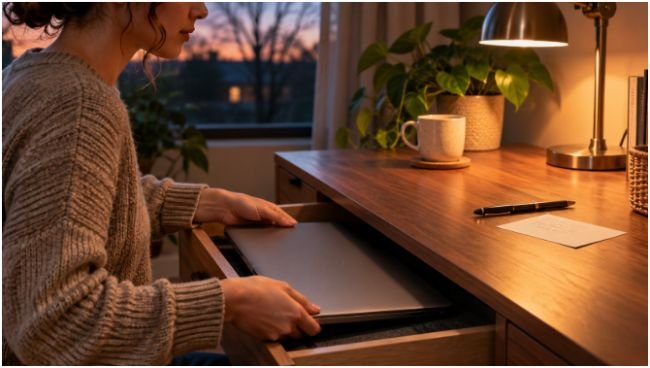
Without a clear closing ritual, unfinished tasks linger in your working memory all evening, a psychological quirk known as the Zeigarnik effect.
At 5:00 PM sharp, I spend ten minutes reviewing what I accomplished and writing down my top three priorities for tomorrow on a physical index card. Next, I shut down my computer, close my office door, and mute all work notifications on my phone. If you work from a studio apartment, put your laptop inside a drawer or closet so it stays completely out of sight. Learning how to separate work and personal life starts with removing visual triggers from your relaxation space.
Executing a Reverse Commute
To lock in the transition, I immediately perform a “reverse commute.” Some days that means hitting the gym; other days it means chopping vegetables while listening to a loud podcast. That sensory shift tells my nervous system the workday is officially dead and buried.
My 2-Week Energy Audit: What Actually Moved the Needle
When I first built this schedule, I tracked my subjective energy levels (on a 1-to-10 scale) every afternoon at 4:00 PM over two weeks. During Week 1, I kept my inbox open all day and ate lunch at my desk. My average 4:00 PM energy score sat at a dismal 4.2, and I felt irritable by dinner.
During Week 2, I enforced the morning screen delay, batched my emails twice a day, and took a strict screen-free lunch. My average 4:00 PM energy score jumped to 7.8. Cutting out continuous context-switching saved me roughly ninety minutes of fragmented work daily, proving that protecting your recovery windows actually increases your total output.
Frequently Asked Questions About Remote Work Burnout
1. How many hours a day should a remote worker actually work?
Most remote knowledge workers achieve peak sustainable output with four to five hours of focused deep work paired with two to three hours of communication and admin.
2. What is the best morning routine for working from home?
The best morning routine delays screen exposure for at least thirty minutes, includes light physical movement outdoors, and swaps pajamas for dedicated daytime work clothes.
3. How do you mentally clock out when working remotely?
Write tomorrow’s top three tasks on paper, physically hide your laptop, mute all Slack or email alerts, and immediately start a physical hobby or workout.
4. Why am I more exhausted working from home than in an office?
Remote work removes natural social breaks and physical boundaries, causing continuous context-switching and invisible overtime that quietly drain your nervous system.
Stop Living at Your Desk and Reclaim Your Living Room
Your living room was never meant to be an extension of corporate headquarters. You don’t need to overhaul your entire life tomorrow morning to break the cycle of chronic exhaustion. Pick just one bookend ritual—either the twenty-minute morning walk or the hard 5:00 PM laptop shutdown—and test it for five consecutive days. Once your brain remembers what true off-the-clock rest feels like, you will never go back to answering emails from the couch.