Learn All Types of Software Design Patterns Now!
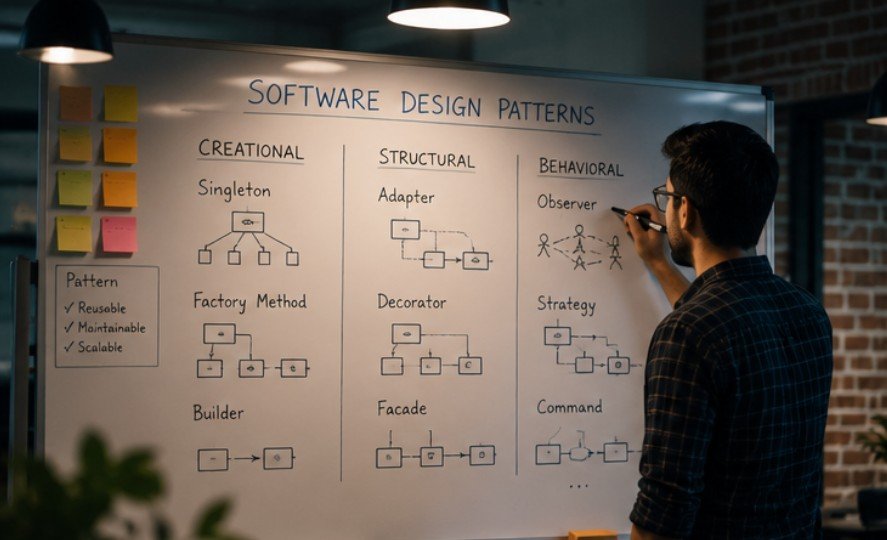
Building applications often feels like assembling complex furniture without instructions until discovering design patterns. Learning the core types of software design patterns completely changed how code gets structured, making projects far easier to maintain and scale. Think of these patterns as proven architectural blueprints that save hours of refactoring frustration down the road.
Software Architecture Tools Make Coding Fun
Every developer eventually hits a chaotic wall where an app codebase turns into tangled spaghetti. Exploring types of software design patterns is like unlocking a cheat code for your engineering workflow.
Instead of reinventing the wheel when connecting databases or managing app states, you get battle-tested shortcuts. Using these templates keeps your code readable for teammates, reduces bugs dramatically, and turns frustrating refactoring sessions into a super smooth experience.
Creational Patterns Make Object Instantiation Effortless
Objects form the core foundation of object-oriented programming, but instantiating them directly across a codebase breeds fragile architecture.
Creational design patterns isolate the logic required for object creation. Instead of instantiating classes directly throughout an application, these patterns handle the heavy lifting behind the scenes. This approach keeps system components decoupled and makes swapping out object types later completely effortless.
The Factory Method Pattern
This pattern provides a dedicated interface for creating objects in a parent class while allowing child classes to alter the exact type of objects created. Imagine a logistics application where new shipping methods like truck or boat need to be supported without rewriting core delivery logic.
Developers using AI coding assistants for web developers can generate factory classes and object-creation logic faster, but they should still review the output for unnecessary complexity, incorrect dependencies, and pattern misuse.
The Singleton Pattern
Singleton ensures that a class has only one single instance throughout the application life while providing a global point to access it. It works great for managing shared system resources like a central database connection pool or global settings.
The Builder Pattern
When dealing with complex objects containing dozens of setup parameters, Builder lets you construct them step-by-step instead of using massive, confusing constructors. It operates just like building a custom burger at a restaurant where ingredients are picked one by one.
Additional Creational Blueprints
Abstract Factory produces entire families of related or dependent objects without specifying their concrete classes directly. Prototype allows applications to copy existing object instances seamlessly to create new ones without depending on their specific classes.
Structural Patterns Assemble Flexible System Structures
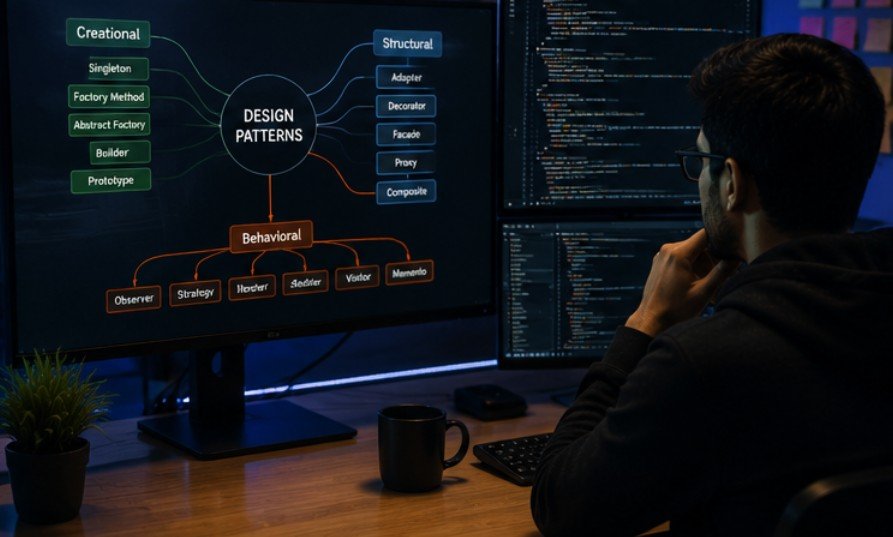
Building large software applications requires combining smaller objects and classes into cohesive structures without making them rigid.
Flexible architecture should also incorporate best practices for secure software development so adapters, proxies, facades, and other structural components enforce safe access, validate data, and limit exposure between connected systems.
Structural patterns focus on how classes and objects inherit and compose with one another to form bigger systems. They ensure that when one part of the application changes, the rest of the overall structure stays completely intact.
The Adapter Pattern
Adapter acts as a bridge between two incompatible interfaces, letting them work together seamlessly. Think of it like a physical travel plug adapter that lets a US power charger plug directly into a European wall outlet.
The Decorator Pattern
Instead of clogging classes with endless inheritance, Decorator lets you wrap objects inside wrapper classes to add new behaviors dynamically at runtime. It works just like adding custom toppings to a base pizza or putting on a raincoat over clothes.
The Facade Pattern
Facade provides a simple, clean interface to a complex framework or group of underlying libraries. Rather than forcing the frontend code to call ten microservices directly, a single facade interface executes the whole workflow effortlessly.
Additional Structural Blueprint Solutions
Proxy acts as a placeholder to control access to another target object safely. Bridge separates an abstraction from its implementation so both can vary independently. Composite treats individual objects and compositions uniformly in a tree structure, while Flyweight shares small parts of state among multiple objects to save memory.
Behavioral Patterns Manage Object Communication Smoothly
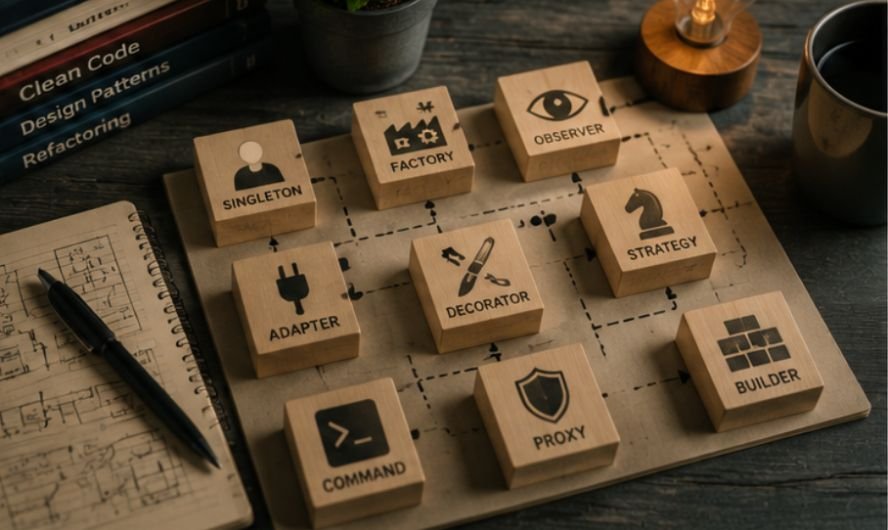
Even the best-built objects are useless if they cannot pass messages and coordinate tasks effectively across your system.
Behavioral design patterns take care of algorithms and responsibility distribution among interacting objects. They ensure components communicate cleanly without becoming tightly coupled or difficult to test.
The Observer Pattern
Observer sets up a subscription system so multiple objects can listen for state changes on another object and react automatically. This powers real-time notifications, event listeners, and live dashboard feeds in modern web applications.
The Strategy Pattern
Strategy takes a family of algorithms, puts each into a separate class, and makes their objects interchangeable at runtime. A payment processing gateway that toggles between credit card, PayPal, or cryptocurrency payment logic uses this exact setup.
The Command Pattern
Command turns requests into standalone objects containing all information about the action. This setup allows applications to queue operations, delay execution, or easily implement full multi-level undo and redo features.
Additional Behavioral Orchestration Mechanics
State changes an object behavior dynamically based on its internal state. Iterator sequentially accesses elements of a collection without exposing its underlying structure. Mediator restricts direct communication between objects and forces them to collaborate through a central mediator, while Template Method defines the skeleton of an algorithm in a superclass.
Types of Software Design Patterns Step-By-Step Application

Applying structural principles to daily software development works best when tackled as a step-by-step process.
- First, identify the underlying architectural bottleneck in your project before writing code, such as tight coupling or messy object creation.
- Next, select the simplest pattern that addresses the problem without adding unnecessary layers of abstraction.
- Finally, implement the pattern using clear class names so teammates immediately recognize the design intent, and refactor as requirements evolve over time.
Frequently Asked Questions
1. What are the types of software design patterns?
Software design patterns are categorized into three main types: Creational, Structural, and Behavioral patterns. They serve as standardized, reusable blueprints to solve common, recurring problems in software engineering.
2. What are the 7 models of SDLC?
The seven SDLC models include Waterfall, Agile, Iterative, V-Model, Big Bang, Spiral, and RAD (Rapid Application Development). Each model defines a unique structured software development build process.
3. What are the top 20 coding patterns?
Top coding patterns include Two Pointers, Sliding Window, Fast & Slow Pointers, Monotonic Stack, Depth-First Search, Breadth-First Search, Dynamic Programming, and Binary Search variants.
4. Are there only 23 design patterns?
No, the classic Gang of Four book cataloged 23 original patterns, but dozens of modern architectural, microservice, and concurrency patterns exist today.
Level Up Your Code Base
Understanding the core types of software design patterns empowers engineers to write flexible, scalable code while avoiding costly architectural mistakes.
Mastering creational, structural, and behavioral principles provides a reliable framework for solving complex programming challenges with confidence.
Explore comprehensive pattern visual guides like Refactoring. Guru or developer resources on Digital Ocean Community to level up your engineering skills today.