
A customer clicks “Pay” once, but a network timeout causes the checkout system to submit the charge twice. Both requests succeed, leaving the customer with two charges for one purchase.
Understanding how to prevent duplicate transactions in payment APIs starts with a simple principle: every payment should have a unique identity that survives retries, connection failures, and repeated requests.
The most reliable approach combines idempotency keys, atomic database operations, payment-state validation, and gateway-level protection. Together, these controls prevent duplicate charges without blocking legitimate purchases.
Make Idempotency the Foundation of Every Payment
Idempotency means repeating the same operation produces no additional intended effect after the first successful execution.
For a payment API, that means five identical requests representing one purchase must not create five separate charges.
Assign a Unique Key to Every Payment Intent
Generate a UUIDv4 when the customer starts a distinct payment attempt. Send that identifier in the API request header.
For example:
POST /api/payments
Idempotency-Key: 8e42c9a1-7f35-4a60-9e2b-12a45c6d7890
Content-Type: application/json
Store the identifier alongside the payment amount, currency, customer, and order reference.
If the request times out, reuse the original key. A new key should represent a genuinely new payment operation, not merely another attempt to obtain a response.
Recognize Requests Before Processing Charges
The server should distinguish among three situations:
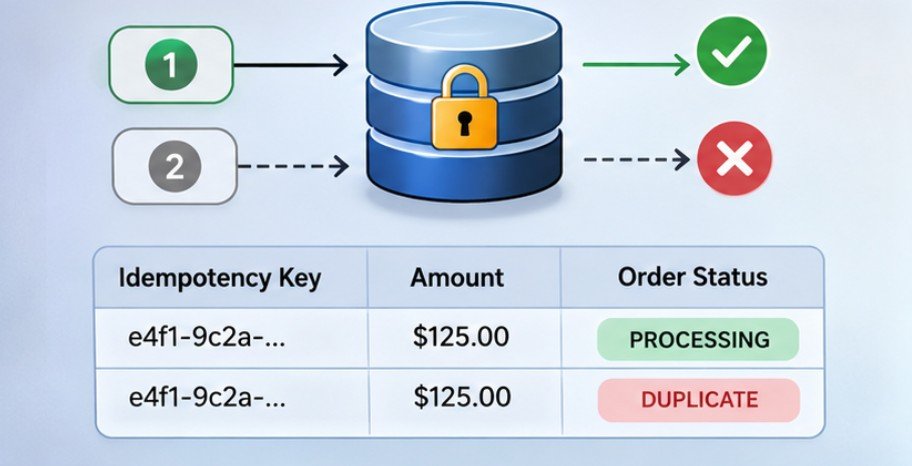
- New request: Register the key, mark the operation IN_PROGRESS, and begin processing.
- Completed request: Return the stored response and HTTP status without charging again.
- Active request: Return an explicit processing response or a documented 409 Conflict, with instructions for checking the existing payment.
Compare a canonical fingerprint of the payment parameters before accepting a repeated key.
If the original request specified $125 and a later request specifies $150, reject the mismatch. An HTTP 422 Unprocessable Entity response is one reasonable API design.
This prevents accidental reuse of an existing key for a different financial operation.
Close the Database Race Condition
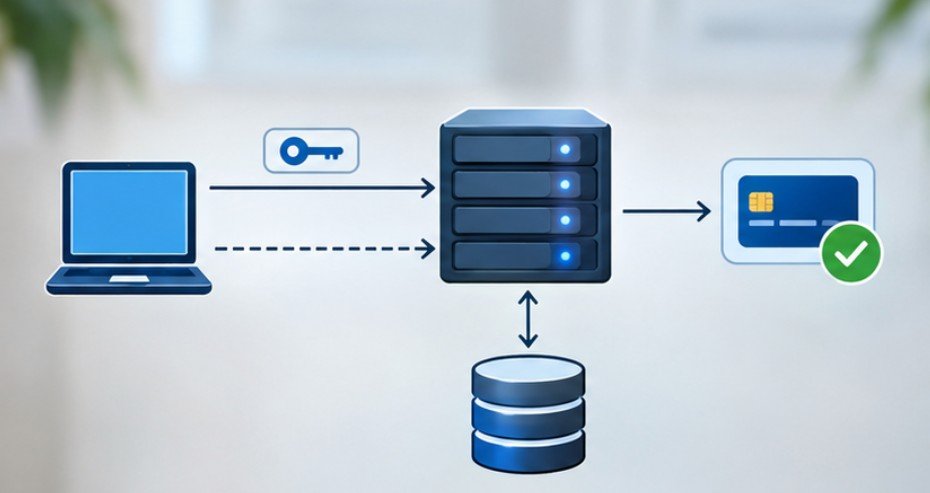
Idempotency checks alone cannot guarantee transaction safety.
Imagine two API requests arriving simultaneously. Both query the database, find no existing record, and attempt to charge the customer.
The problem is a race condition: both requests pass the validation before either reserves the payment operation.
The OWASP race-condition guidance describes the risks of concurrent requests accessing shared application state without appropriate coordination.
Use Unique Constraints and Atomic Inserts
Create a database uniqueness rule for the merchant and idempotency key combination.
For PostgreSQL, a simplified reservation could use:
INSERT INTO payment_requests
(merchant_id, idempotency_key, status)
VALUES
(42, ‘8e42c9a1’, ‘IN_PROGRESS’)
ON CONFLICT
(merchant_id, idempotency_key)
DO NOTHING;
Only the request that successfully inserts the record should own the initial payment operation.
Other requests must inspect the existing record rather than independently contacting the gateway.
Do not rely exclusively on a preliminary cache lookup. Cache expiration, distributed servers, and simultaneous writes can undermine that approach.
Keep the reservation durable, and define recovery procedures for interrupted workers.
Protect the Entire Checkout Process
A payment transaction involves more than sending money. Order creation, authorization, capture, fulfillment, and notifications must remain consistent.
Establish Strict Payment States
Represent the order lifecycle using controlled transitions:
PENDING → PROCESSING → PAID
Add explicit states for failed, canceled, and uncertain outcomes.
Once an order reaches PAID, ordinary checkout requests must not initiate another charge against it.
A payment stuck in PROCESSING requires investigation rather than an automatic new charge.
For multi-step systems, coordinate payment processing with order updates using durable jobs or transactional outbox patterns.
Prevent Repeated Clicks
Disable the payment button immediately after submission and display a clear processing indicator.
Provide an order-status lookup if the connection drops.
The same attention to transaction reliability is essential when designing mobile banking experiences. Users expect payment confirmations, clear transaction statuses, intuitive navigation, and secure interactions when managing their finances through mobile applications.
Exploring how to design a user-friendly mobile banking application can help developers understand how interface design, transaction visibility, and security features contribute to a smoother digital banking experience.
However, frontend restrictions are only usability safeguards. Automated clients, browser refreshes, and direct API requests can bypass them.
Backend protection remains essential.
Teams improving checkout reliability should also coordinate payment messaging with their landing page and customer conversion experience so customers understand what happens after submitting an order.
Coordinate Idempotency With Payment Gateways
Your internal payment protection should extend to external processors.
Where supported, forward a stable idempotency identifier to the gateway’s payment-creation endpoint.
For example, an application receiving three retries for order ORD-7821 should reuse the same gateway payment reference rather than create a new payment each time.
Gateway behavior varies. Providers may differ in key-retention periods, concurrent-request handling, and which failures are replayable.
Beyond transaction reliability, businesses should also evaluate the financial costs associated with their payment processing infrastructure. Gateway pricing, transaction fees, settlement charges, and other service costs can affect the overall economics of handling online payments. Exploring how to optimize payment processing fees for online businesses can help businesses compare payment providers, identify unnecessary charges, and manage transaction expenses more efficiently without compromising payment reliability.
Maintain durable internal records beyond the gateway’s documented key-expiration window when necessary.
A common operational starting point is 24–48 hours of idempotency-record retention, but this is not a universal standard. Retain the order-to-payment mapping for the appropriate business and audit lifecycle.
Never assume an expired gateway key will still prevent duplicate charges.
Treat Webhooks as Repeatable Notifications
Payment processors often deliver webhook events more than once.
A duplicate notification should not trigger another fulfillment action, customer credit, subscription activation, or financial entry.
Store the provider’s event identifier and enforce uniqueness before applying the event’s business effects.
Validate webhook authenticity and reconcile the notification against the known payment and order records.
For secure handling, the OWASP Webhook Security Cheat Sheet recommends duplicate-event controls and idempotent processing.
Keep webhook event deduplication separate from payment-request idempotency. They protect different stages of the transaction lifecycle.
Test Payment Failures Before They Reach Customers

A working checkout in ideal conditions proves very little about duplicate-charge prevention.
Use a gateway sandbox and deliberately introduce failure scenarios.
Six Tests Every Payment API Should Pass
- Submit the same payment request repeatedly using one key. Confirm only one payment operation is created.
- Send simultaneous requests from multiple application instances. Verify a single request acquires processing ownership.
- Change the amount while keeping the original key. Confirm the server rejects the conflicting payload.
- Disconnect the client after the gateway accepts the charge. Verify reconciliation prevents a second payment.
- Deliver the same successful-payment webhook several times. Confirm fulfillment occurs once.
- Retry after key expiration or worker failure. Verify the existing order and processor reference prevent accidental recharging.
Measure duplicate-request frequency, unresolved payment states, reconciliation delays, and blocked duplicate-charge attempts.
Avoid storing full card details or sensitive authentication values in idempotency logs. The PCI Security Standards Council’s payment-data guidance explains restrictions on retaining sensitive authentication data after authorization.
Handle Duplicate Payments That Already Occurred
Prevention cannot eliminate every operational mistake. If duplicate charges occur, compare internal order records with gateway settlement information to identify the extra transaction.
Duplicate charges can also be a warning sign of suspicious payment activity, particularly when repeated transactions involve unusual amounts, multiple payment attempts, or unfamiliar customer details.
Ecommerce businesses should distinguish accidental duplicate processing from deliberate fraudulent behavior by examining transaction patterns, customer information, and payment histories.
Learn how to detect fraudulent transactions in ecommerce websites to understand how monitoring suspicious activity can help protect payment systems and reduce financial losses.
Determine whether each transaction is authorized, captured, settled, or refundable.
For ACH payments, the Nacha guidance on ACH reversals identifies duplicate entries as a permissible reversal reason, subject to applicable rules and deadlines.
For card payments, use the processor’s supported void or refund process rather than attempting an unrelated new transaction. Notify affected customers clearly and document the correction.
Frequently Asked Questions
1. What is the best way to prevent duplicate payment requests?
Combine unique idempotency keys, atomic database constraints, payment-state validation, and gateway-level duplicate protection. No single frontend or backend safeguard should carry the entire responsibility.
2. How long should an idempotency key remain valid?
Retention depends on the processor and business workflow. Choose a period covering expected retries, while preserving durable payment references for reconciliation after the key expires.
3. Can payment webhooks cause duplicate transactions?
Repeated webhooks usually do not create charges by themselves, but poorly designed handlers can repeat refunds, captures, fulfillment actions, or ledger updates. Deduplicate events and enforce business-state rules.
4. Should failed payment attempts use the same idempotency key?
Retry uncertain outcomes using the existing key until the original result is resolved. A confirmed failure may require a new operation, depending on the gateway’s documented behavior.
A Reliable Payment System Begins Before the First Charge
Preventing duplicate payments requires designing for uncertainty rather than assuming every API request will receive a response.
The most important lesson in how to prevent duplicate transactions in payment APIs is that a network failure must never become permission to initiate another financial operation.
I would prioritize durable payment identifiers, atomic request ownership, gateway reconciliation, and concurrency testing before introducing additional checkout features.
A payment system earns trust not simply by charging customers successfully, but by knowing when it must never charge them again.