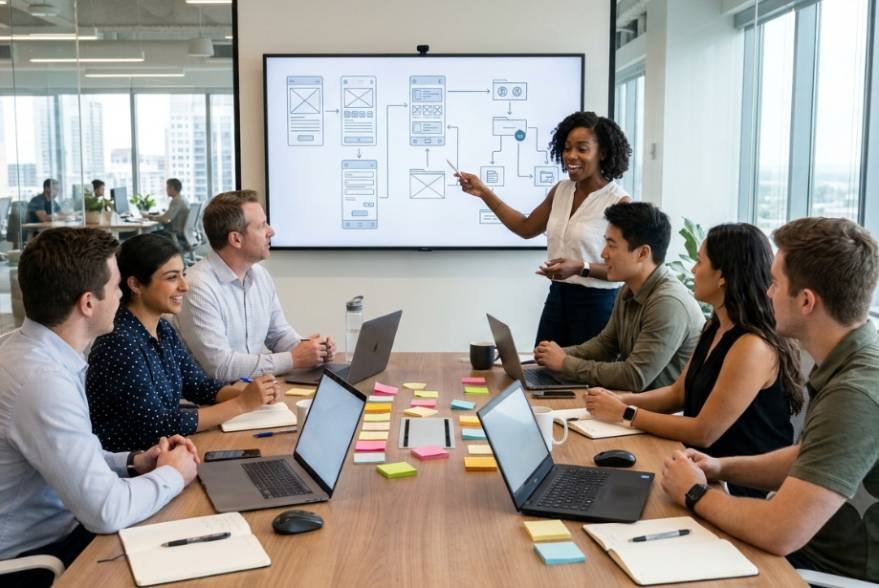
When I begin a software project, I do not start with a feature wish list. I start with the business problem, the people affected by it, and the outcome the product must deliver. Unclear requirements often lead to scope creep, delayed releases, and expensive rework.
For US software teams, SaaS companies, agencies, and enterprise developers, following software requirements gathering best practices creates a shared foundation before design and engineering move too far. The goal is to define what users need, what the system must accomplish, what constraints matter, and how success will be verified.
What Is Software Requirements Gathering?
Software requirements gathering, also called requirements elicitation, is the process of discovering, analyzing, documenting, prioritizing, validating, and managing what a system needs to do.
Good discovery covers business goals, user workflows, integrations, security, performance, dependencies, and project constraints.
How Do You Identify the Right Stakeholders?
I never rely only on the person paying for the project. A stakeholder map should include primary users who perform daily tasks, secondary users who depend on reports or outputs, and hidden stakeholders such as security, compliance, legal, infrastructure, and operations teams.
This broader view helps teams discover constraints before they become expensive development problems.
Which Requirements Elicitation Techniques Work Best?

No single method works for every project. Interviews provide deep context, surveys reveal patterns across larger groups, and Joint Application Development workshops help cross-functional teams resolve conflicting expectations. Contextual observation uncovers steps users may forget to mention.
Document analysis, analytics, user stories, use cases, and prototypes can add more evidence.
When requirements involve complex workflows or uncertain user expectations, following a structured software prototyping process for new products can help teams test concepts, gather stakeholder feedback, and clarify functionality before full-scale development begins.
How Do Jobs to Be Done and User Journeys Improve Discovery?
Instead of asking only, “What feature do you want?” I ask, “What are you trying to accomplish?”
The Jobs to Be Done approach reveals the outcome behind a request. A manager asking for a dashboard may really need to identify underperforming locations before a weekly review.
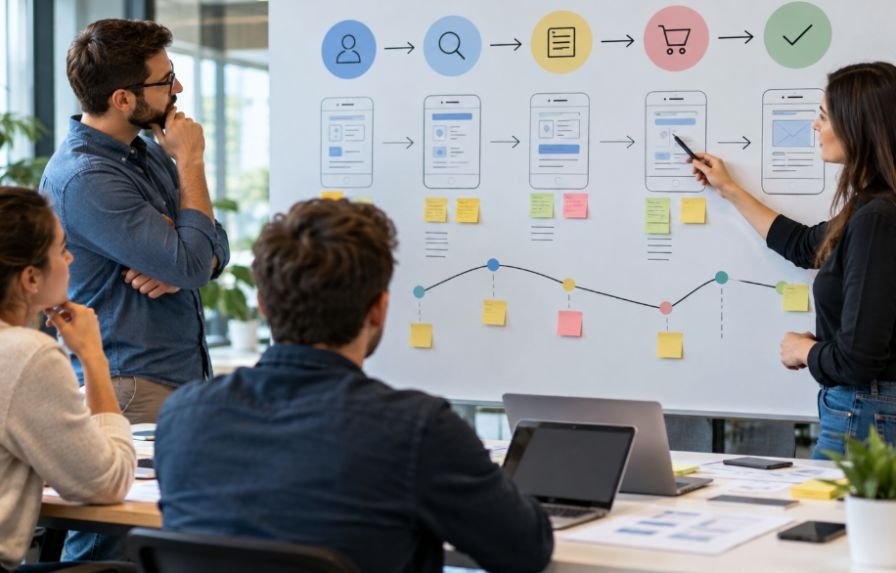
Once that outcome is clear, map the key actions, handoffs, and pain points in the user journey.
How Do You Separate What the System Needs From How It Is Built?
Requirements should describe the necessary outcome before prescribing implementation.
“The system must use a specific database” may unnecessarily restrict architecture. A stronger requirement would state that the system must securely store customer records and retrieve them within an agreed response time.
This keeps business requirements separate from architectural decisions unless a specific technology is genuinely mandatory.
For projects involving mobile applications, understanding mobile app backend development best practices can help teams define requirements for API communication, secure data handling, backend reliability, and scalability before selecting an implementation approach.
What Is the Difference Between Functional and Non-Functional Requirements?
Functional requirements describe what the software does, such as registering users, processing payments, generating reports, or sending password-reset links.
Non-functional requirements describe how the system behaves. They cover performance, scalability, reliability, security, availability, accessibility, backup expectations, and regulatory constraints.
Both matter because a working feature can still fail if it is too slow, unreliable, or unable to handle expected demand.
How Do You Write Testable Software Requirements?
Avoid subjective terms such as “fast,” “simple,” or “user-friendly” unless they are measurable.
“The dashboard should load quickly” is vague. “The main dashboard should display within two seconds for 95% of requests under the agreed production workload” gives developers and QA teams a clear target.
If a QA engineer cannot create a pass/fail test for a requirement, it probably needs revision. Acceptance criteria should define what proves the requirement is complete.
How Should You Prioritize Requirements?

The MoSCoW method separates requirements into Must Have, Should Have, Could Have, and Won’t Have for the current release. It works particularly well for MVP planning because it protects the smallest feature set required to deliver value.
The Kano Model distinguishes basic expectations, performance needs, and delighters. Prioritization should also consider value, risk, effort, and dependencies.
This prevents every stakeholder request from being treated as equally critical.
How Can Prototypes and MVPs Validate Requirements?
Wireframes, clickable prototypes, no-code workflows, and limited MVPs can reveal misunderstandings before expensive engineering begins.
Teams may use a fake-door or explainer MVP to test demand, a concierge MVP to deliver value manually, a piecemeal MVP built from existing tools, or a single-feature product to test one critical behavior. Dropbox’s early explainer video and Groupon’s simple early setup are well-known examples of learning before building a full platform.
Early Airbnb also relied heavily on manual processes while validating whether customers would actually use its accommodation model. These approaches reinforce an important principle: build enough to learn before committing resources to a complete system.
For a more detailed approach to validating product assumptions before expanding development, explore how to build a minimum viable product to prioritize essential features, test customer demand, and reduce unnecessary development costs.
What Is Bidirectional Requirements Traceability?
Bidirectional traceability connects each important requirement backward to a business goal and forward to implementation and testing.
A practical chain is:
Business objective → requirement → user story → architectural component → development task → acceptance criteria → test case.
That connection gives development teams clearer accountability and makes requirement changes easier to analyze.
How Is Requirements Gathering Different in Agile and Waterfall?
Agile teams usually refine requirements continuously through backlogs, user stories, acceptance criteria, sprint reviews, and stakeholder feedback. Changes are expected as teams learn more about users and the product.
Waterfall projects generally define requirements more extensively during upfront discovery and use formal specifications and structured change control later.
Neither methodology eliminates the need for clear requirements. The main difference is when teams detail, validate, and update them.
Can AI Help With Requirements Gathering?
AI can summarize interviews, organize notes, identify conflicting statements, draft user stories, generate discovery questions, suggest edge cases, and create preliminary acceptance criteria.
AI output still needs human review because important business rules and constraints may be missing. I see AI as an analysis assistant rather than the final decision-maker.
How Should Requirements Change After an MVP Launch?
Requirements gathering should not stop when development ends.
After launch, I would examine product analytics, user interviews, customer support requests, usability testing, and adoption patterns. These signals reveal whether the software actually solves the original problem.
A weak result does not automatically mean the team needs more features. The target audience, workflow, value proposition, or original requirement may need to change.
Frequently Asked Questions
1. What are the best practices for gathering software requirements?
The strongest software requirements gathering best practices include stakeholder segmentation, mixed elicitation methods, Jobs to Be Done analysis, user journey mapping, measurable requirements, structured prioritization, prototypes, acceptance criteria, and bidirectional traceability.
2. What is the difference between requirements gathering and requirements elicitation?
Requirements elicitation focuses on discovering stakeholder and user needs. Requirements gathering usually includes discovery, analysis, documentation, prioritization, validation, traceability, and ongoing management.
3. Should an MVP include every high-priority feature?
No. An MVP should include only the capabilities needed to deliver and test its core value. Other features can stay in the backlog until real user evidence supports building them.
4. How do you prevent scope creep during requirements gathering?
Clearly document project boundaries, assumptions, dependencies, excluded functionality, acceptance criteria, and priorities. Any new requirement should be evaluated against business goals before entering the development backlog.
Final Thoughts
When I look at successful software projects, the strongest teams do more than collect feature requests. They connect business objectives to user needs, translate those needs into measurable requirements, prioritize realistically, and validate assumptions before investing heavily in development.
Using software requirements gathering best practices alongside prototypes, MVP testing, traceability, and continuous feedback can help US development teams reduce avoidable rework while making better product decisions. The objective is not to create the longest requirements document possible. It is to create enough shared clarity and evidence to build the right software for the right users.