Master Software Development Standards for Medical Devices Easily
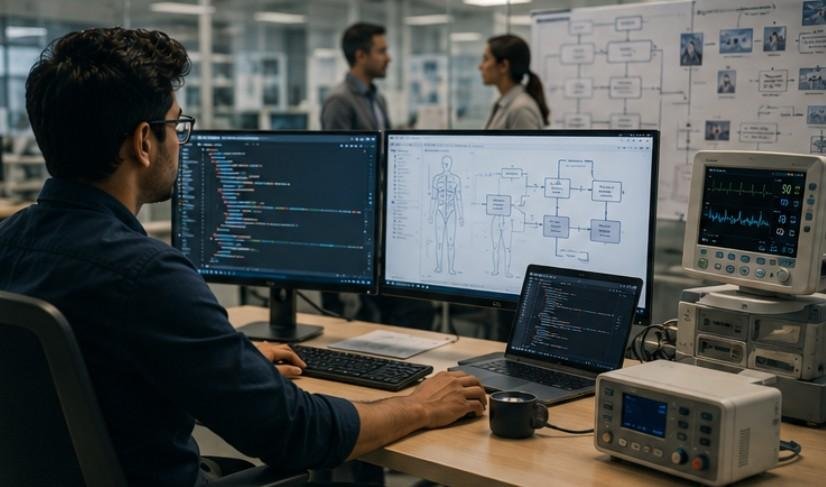
Building code that directly influences human health demands exceptional attention to technical accuracy and compliance. When our engineering team first stepped into health tech, we discovered that mastering software development standards for medical devices is what transforms ambitious code into life-saving software products.
Navigating complex healthcare regulations can seem daunting when you look at massive standard documentation manuals. However, once you understand how these international rules protect patients, writing compliant code becomes a seamless extension of good software design.
This comprehensive guide breaks down every essential framework, safety class, and compliance activity your engineering team needs to succeed.
Understanding Core Medical Development Frameworks
Let us explore the foundational international regulations that shape every compliant healthcare engineering project.
IEC 62304 Software Lifecycle Management
This primary standard dictates how developers plan, construct, and maintain medical software systems.
IEC 62304 serves as the main roadmap for managing medical device software life cycle processes across all development phases. It mandates detailed planning, requirements analysis, architectural design, unit implementation, verification testing, and ongoing software maintenance.
By following this standard, engineering teams ensure that every software iteration is fully documented and controlled. Whether you build embedded firmware or standalone cloud platforms, IEC 62304 provides the structural discipline required for safe releases.
ISO 13485 Quality System Management
A strong quality system guarantees that organizational processes support consistent and reliable engineering outcomes.
ISO 13485 specifies quality management system requirements tailored specifically for medical device design, manufacturing, and software development. It ensures that development environments maintain strict change management, version control, and document retention protocols.
Aligning your development team with ISO 13485 demonstrates to regulatory authorities that your organization follows repeatable quality standards. It bridges technical coding practices with high-level corporate governance and compliance.
ISO 14971 Risk Analysis Protocols
Identifying potential software hazards before they reach patients is the core mission of risk management.
ISO 14971 guides the systematic application of risk management to identify, evaluate, and control hazards associated with medical device software. Developers must evaluate every potential code failure mode and implement software risk controls to mitigate patient harm.
Integrating risk analysis directly into your sprint planning ensures that safety considerations actively shape your software architecture. Continuous risk evaluation remains mandatory throughout the entire software lifecycle.
IEC 62366-1 Usability Engineering Practices
Designing intuitive user interfaces prevents operator mistakes that could jeopardize clinical patient safety. Use best practices for secure software development

IEC 62366-1 focuses on usability engineering to minimize user errors and optimize interface designs for real-world clinical environments. It requires developers to analyze how clinicians or patients interact with the software under everyday stress.
Conducting human factors testing helps eliminate confusing navigation, misleading alerts, and ambiguous visual data displays. Thoughtful usability engineering turns complex health technology into safe, user-friendly tools.
Software Safety Classifications Demystified
Regulators categorize software based on potential patient risks to determine the necessary development rigor.
Class A Low Risk Software
Class A represents applications where software failures cannot result in any physical harm or injury.
This classification applies to basic administrative or non-invasive software tools that carry zero potential for health damage. Because the safety risk is minimal, developers follow streamlined design controls and simplified testing documentation.
Even with reduced regulatory demands, Class A software must still maintain fundamental code quality, basic lifecycle tracking, and proper version control.
Class B Moderate Risk Systems
Class B covers software solutions where malfunction could lead to non-serious or temporary physical injuries.
Software in this tier requires comprehensive design documentation, detailed architectural reviews, and rigorous integration testing. Engineers must demonstrate clear requirement traceability and perform systematic risk assessments for all features.
Most diagnostic monitoring tools and mobile health tracking apps fall into Class B, balancing thorough regulatory oversight with development agility.
Class C High Risk Healthcare Code
Class C represents critical medical software where defects could cause severe permanent injury or death.
Engineering teams building Class C software face the highest level of regulatory scrutiny, requiring exhaustive unit testing, rigorous static code analysis, and deep structural verification. Every architectural decision and code branch must be rigorously documented and justified.
Examples include software controlling life-support systems, automated insulin pumps, and radiation therapy equipment, where unhandled bugs carry catastrophic consequences.
Essential Compliance Execution Activities
Executing specific compliance practices turns theoretical regulatory guidelines into tangible, audit-ready engineering artifacts.

Rigorous Design Controls Implementation
Documenting every step from initial user needs to final release is fundamental to regulatory approval.
Design controls require establishing clear design inputs, translating them into technical specifications, and verifying that final outputs match specifications. Developers maintain living records through detailed requirement management tools that link every feature to business goals.
Creating a comprehensive history file ensures your engineering team can demonstrate full regulatory compliance during official FDA or European audits.
Comprehensive Verification and Validation Testing
Systematic testing confirms that your code executes perfectly and fulfills genuine clinical requirements.
Verification focuses on proving that software meets specified technical requirements through unit testing, code reviews, and integration checks. Validation proves that the completed device meets actual user needs and clinical intended uses in real operational conditions.
Combining automated continuous integration suites with formal clinical usability testing ensures both code stability and practical user satisfaction.
Advanced Medical Cybersecurity Frameworks
Protecting connected healthcare devices against malicious attacks and privacy breaches is an absolute necessity.
Modern software teams utilize specialized cybersecurity frameworks like AAMI SW96 or UL 2900-2-1 to systematically identify, manage, and mitigate security vulnerabilities. These frameworks mandate threat modeling, secure coding standards, regular vulnerability testing, and encrypted data communications.
Implementing robust cybersecurity controls protects sensitive patient health records while maintaining system integrity against evolving digital threats.
Implementing Software Development Standards for Medical Devices Step-by-Step
Following a structured, practical approach simplifies applying compliance standards across active engineering projects.

First, establish your software safety classification and intended use statements before writing production code. Conduct an initial ISO 14971 risk evaluation to determine whether your application qualifies as Class A, Class B, or Class C under IEC 62304 guidelines. This early determination defines the required documentation scope and testing intensity for the entire project.
Second, construct a dynamic bi-directional traceability matrix connecting user requirements to software design specifications, risk controls, and test cases. Link every risk identified during hazard analysis directly to specific code mitigations and verification tests. Maintaining automated traceability tools prevents missing safety controls during rapid feature updates.
Third, embed automated compliance checks into your continuous integration and deployment pipeline. Configure static analysis tools to enforce secure coding rules, execute automated unit test suites on every pull request, and generate automated test execution reports. Combining automated pipeline checks with periodic team reviews keeps your development pace fast while keeping your project audit-ready at all times.
Frequently Asked Questions
1. What are the major standards for medical device software development?
The primary regulations governing healthcare software development are IEC 62304 for lifecycle processes, ISO 14971 for risk assessment, ISO 13485 for quality management systems, and IEC 62366-1 for usability engineering.
2. What is the ISO standard for software as a medical device?
ISO 13485 defines quality management systems for Software as a Medical Device, while ISO 14971 governs risk management. Additionally, ISO/IEC 82304-1 provides health software safety requirements for standalone digital applications.
3. Is IEC 62304 mandatory?
While international technical standards are technically voluntary frameworks, global regulatory agencies like the FDA and EU MDR recognize IEC 62304 as state-of-the-art compliance. Adhering to it is essential for market approval.
4. What are the NIST standards for medical devices?
NIST frameworks, such as NIST SP 800-53 and SP 800-30, provide comprehensive cybersecurity guidelines that help medical device developers protect connected health software against cyber vulnerabilities and unauthorized data breaches.
Regulatory Heroics: Launch Compliant Healthcare Code with Confidence
Mastering software development standards for medical devices is the ultimate mark of engineering quality and professionalism. By integrating IEC 62304 lifecycles, ISO 14971 risk mitigations, and modern automated testing pipelines into your workflow, your team can construct revolutionary digital health solutions with ease. Emphasizing compliance early ensures your code consistently safeguards patient lives while accelerating successful market launches.